

The Jackery Explorer 1000 Pro is a 1,002Wh portable power station with a 1,000W pure sine wave inverter (2,000W surge) and a folding carry handle. It is built for people who want about 1kWh of power in a unit light enough to lift into a 4WD, carry to a caravan or move around a worksite.
This guide covers what it can run, how it charges, what independent testers measured, and who should look at a different unit instead.
Visual Overview: Ports, Layout & Solar Setup
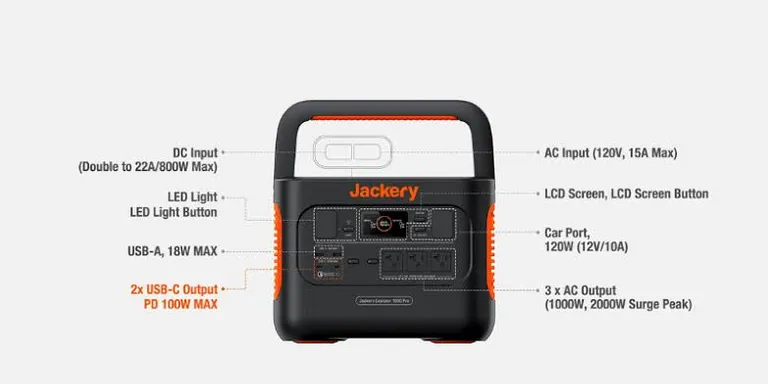
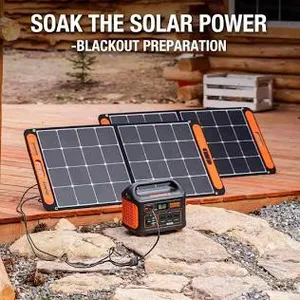
Port & Interface Diagram along with solar panel set up.
Key Technical Specifications
| Feature | Technical Specification |
|---|---|
| Battery Capacity | 1,002 Watt-hours (Wh) |
| Cell Chemistry | Lithium-ion (NMC), 1,000 cycles to 80% capacity |
| AC Output | 1,000W continuous (2,000W peak surge), pure sine wave |
| DC Outputs | 1x 12V/10A car port (120W max) |
| USB Outlets | 2x USB-C PD (100W max each), 2x USB-A Quick Charge 3.0 (18W max) |
| AC Wall Charging | About 1.8 hours (100V to 120V or 230V fast charging) |
| Solar Input | Dual 800W max (DC8020 inputs), about 1.8 hours with 4x SolarSaga 200W |
| Weight | 11.5 kg (25.4 lbs) |
| Dimensions | 34 x 26.2 x 25.5 cm |
| Price (Australia) | Approx: $1,600 to $2,000 in Australia November 2026 (Check for price changes) |
| Warranty | 3 years listed by Australian retailers |
How it charges
From the wall. Jackery quotes about 1.8 hours for a full charge. NextPit’s test measured 108 minutes, which matches. The power supply is built in, so there is no separate charging brick.
From a car. The box includes a car charger cable, an AC charge cable and a DC7909 to DC8020 adapter.
From solar. The unit can be charged with Jackery’s SolarSaga panels (Australian retailers list 80W and 200W versions, sold separately) or other panels that suit its input limits. Check the voltage and current limits in the manual before you connect anything.
How fast solar recharges the unit depends on where you are. As a rough guide, a 200W panel produces about 200W × sun hours ÷ 1.25 in watt-hours a day. That’s around 720Wh on a 4.5-sun-hour day and around 400Wh on a 2.5-hour winter day. At those rates, refilling the 1,002Wh battery from empty with one panel takes roughly 1.4 days and 2.5 days. Jackery’s quoted 1.8 hours for solar charging assumes four 200W SolarSaga panels in ideal conditions.
Australian sun levels
Average daily peak sun hours by city
Higher means more solar energy from every panel. Use the winter figure to size an off-grid system that must work all year.
| City | Annual average | Winter (about) | What it means |
|---|---|---|---|
| Alice SpringsNT | 4.0 | Strong all year; heat trims panel output | |
| DarwinNT | 5.5 | Sunny dry-season winters; cloudier wet season | |
| PerthWA | 2.5 | Great summers; winter drops sharply | |
| BrisbaneQLD | 3.5 | Reliable sun all year | |
| AdelaideSA | 2.0 | Big summer to winter gap | |
| SydneyNSW | 2.5 | Moderate winters | |
| MelbourneVIC | 1.5 | Cloudier; size up for winter | |
| HobartTAS | 1.5 | Lowest winter sun; plan extra panels or battery |
Rounded planning figures for a flat, unshaded panel. The Bureau of Meteorology reports solar exposure in MJ/m²; divide by 3.6 to get peak sun hours. Check the Bureau of Meteorology solar exposure maps for your exact location, then plug your number into our solar and battery calculator.
What It Can Run
The 1,000W inverter suits most camping and remote-work loads: a 12V compressor fridge, laptops, LED lighting, a TV, a CPAP machine and phone and tablet charging. The 2,000W surge rating helps with devices that draw more for a moment when they start, such as fridge compressors.
It will not run high-draw heating appliances, such as most kettles, heaters and large power tools, which typically need more than 1,000W. Check the label on each appliance.
Ports: two USB-C PD ports (100W each), two USB-A Quick Charge ports (18W each), a 12V/10A car port and AC outlets. The two 100W USB-C ports can charge many laptops without an AC adapter.
A rough runtime example. Independent testing (below) found about 835Wh of usable energy from a full charge. A small 12V fridge using around 400Wh a day, as in our portable solar guide, would run for about two days on that alone. Add other devices and it will be less.
What independent testers found
- Charging time: NextPit measured a full charge in 108 minutes.
- Efficiency: NextPit measured about 835Wh coming out of the unit for 1,064Wh put in, roughly 78%. TechRadar’s figure was around 85%. Testing conditions differ, so plan on roughly 800 to 850Wh of usable energy from the 1,002Wh rating.
- Noise: NextPit found the fans barely audible, even while charging.
- Display and controls: NextPit found the display clear even in direct sunlight, but the buttons hard to feel. TechRadar describes a minimalist interface where any button wakes the screen and it switches off after about 30 seconds.
- Build and handle: NextPit praised the solid design and the folding handle, which also lets you stack items on top. The ports have rubber covers.
- Other notes: NextPit said the unit supports pass-through charging and can act as a UPS, but it has no app and the built-in LED light is of limited use.
Strengths and limitations
Strengths
- Fast AC charging, confirmed by an independent measurement
- Light for its capacity at 11.5 kg
- Two 100W USB-C PD ports
- Quiet fans (per NextPit)
- Folding handle and rubber port covers
Limitations
- NMC battery chemistry: rated for about 1,000 cycles to 80%. Units using LiFePO4 chemistry, such as the EcoFlow DELTA 2 and the BLUETTI AC180, are typically rated for more cycles, which matters if you cycle it daily.
- Not waterproof: keep it out of rain and spray.
- Fixed capacity: there is no expansion battery option.
- No app.
- Price: at roughly $1,600 to $2,000 it sits at the higher end for 1kWh.
Who Should Buy It
A good fit: weekend campers, 4WD tourers, remote workers and anyone who wants a light 1kWh unit for occasional use or home backup, where quick charging and easy carrying matter most.
Look elsewhere if: you plan to cycle it daily for years (consider LiFePO4), you need to use it in wet conditions, you want to expand capacity later, or you need to run loads above 1,000W.
Final Verdict
Based on its specifications and independent testing, the Jackery Explorer 1000 Pro is a light, quick-charging 1kWh power station with a solid build. Its main trade-offs are the NMC battery’s lower cycle rating, the lack of water resistance and the price. For occasional camping and backup use it is a strong option. For daily heavy cycling, a LiFePO4 unit is a safer long-term choice.
See how it compares in our best portable power stations in Australia roundup, and size your setup with our off-grid solar and battery calculator.
Before You Buy
- Check the current price and warranty with an Australian seller or Jackery Australia.
- Confirm the solar input limits if you plan to use panels.
- Add up the watts of the devices you want to run and check they sit under 1,000W.