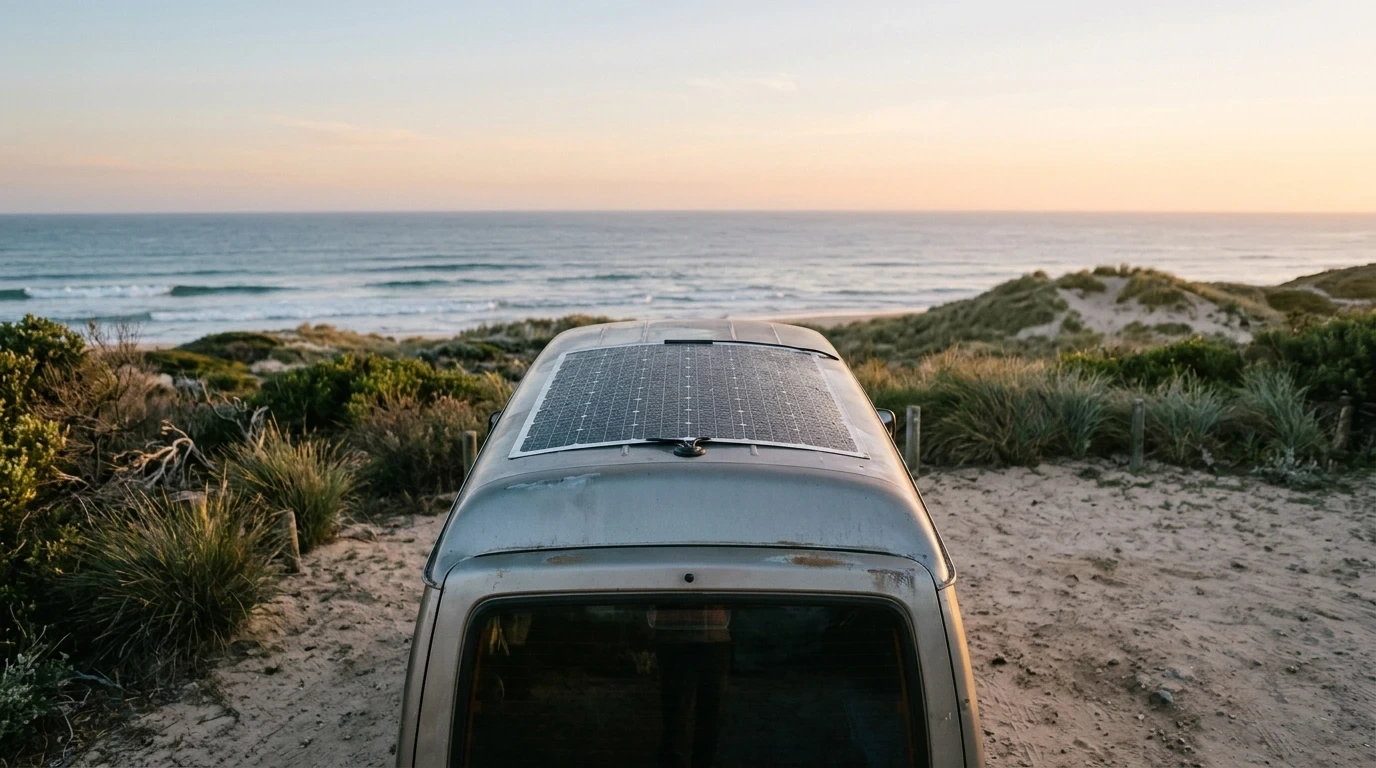
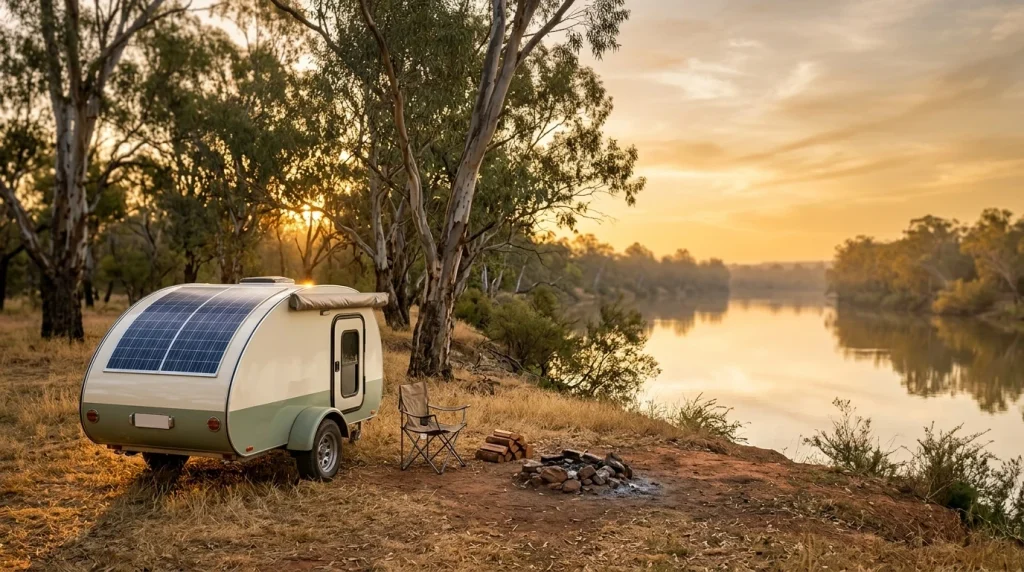
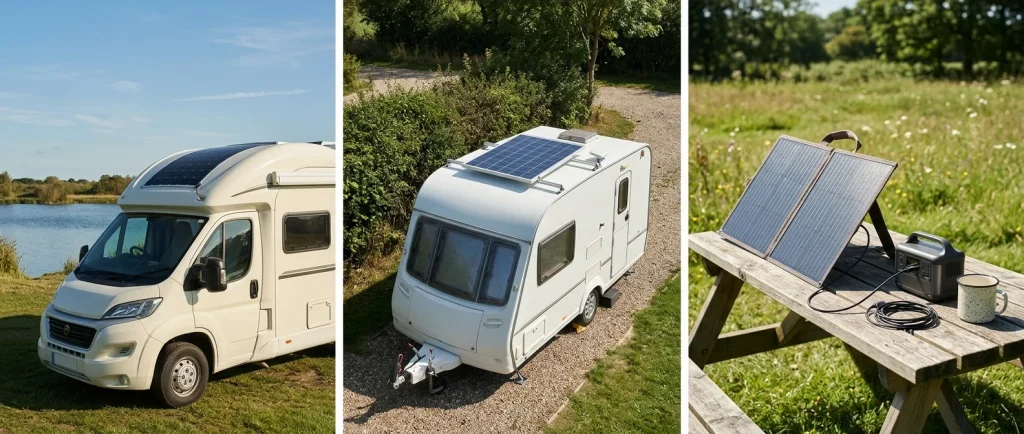
If your caravan roof is curved, your campervan has no room for a rack, or you want solar on a boat deck, a glass panel in an aluminium frame may not suit. Flexible solar panels are thin and light enough to follow a curve, which is why they are popular on campervans, teardrop trailers and boats.
They are not the best choice everywhere. This guide explains how flexible panels work, where they make sense, where they don’t, and how to mount, wire and size them.
Short answer: Choose a flexible panel when weight, a low profile or a curved surface matters more than lifespan and cost per watt. For a flat roof where you have the space, a rigid panel usually lasts longer and costs less per watt. Check the bending limit and warranty on the datasheet before you buy.
What is a flexible solar panel?
A flexible solar panel uses thin solar cells laminated into a light, bendable sheet, usually only a few millimetres thick. Most use the same monocrystalline silicon cells as rigid panels, but without the glass and aluminium frame, which is why they weigh so much less. Weight is often well under half that of a glass panel of the same wattage.
The trade-off is that the cells are more exposed to heat and flexing, so flexible panels commonly come with shorter warranties than rigid ones. Always check the datasheet for the stated bending limit, which for many panels is only a modest curve, often around 30 degrees.
Flexible, rigid and portable panels compared
| Feature | Flexible panel | Rigid glass panel | Portable folding panel |
|---|---|---|---|
| Weight | Lightest for its wattage | Heaviest | Light to medium |
| Fits a curved surface | Yes, within its bending limit | No | Not applicable (not fixed) |
| Typical lifespan | Shorter; check the warranty | Longest, often 25 years | Moderate; hinges and fabric wear |
| Heat tolerance | Weaker if bonded flat with no air gap | Good, with air flowing behind | Good, because it sits in the open |
| Cost per watt | Mid-range | Lowest | Highest |
| Best for | Campervans, teardrops, boats, weight-limited roofs | Permanent roofs, cabins, sheds | Camping and power stations |
If you would rather carry a panel than fix one down, see our portable and foldable solar kits guide.
Where flexible panels make sense
- Curved or domed roofs: many campervans, pop-tops and teardrop trailers have no flat surface for a rigid panel.
- Weight-limited vehicles: every kilogram counts on a caravan roof or a 4WD canopy lid.
- Boats: thin, low-profile panels suit decks and bimini tops. Check that the panel is rated for marine use, and for foot traffic if you will walk on it.
- Low-profile or stealth setups: no frame means nothing to snag and no extra drag.
Where flexible panels are a poor fit
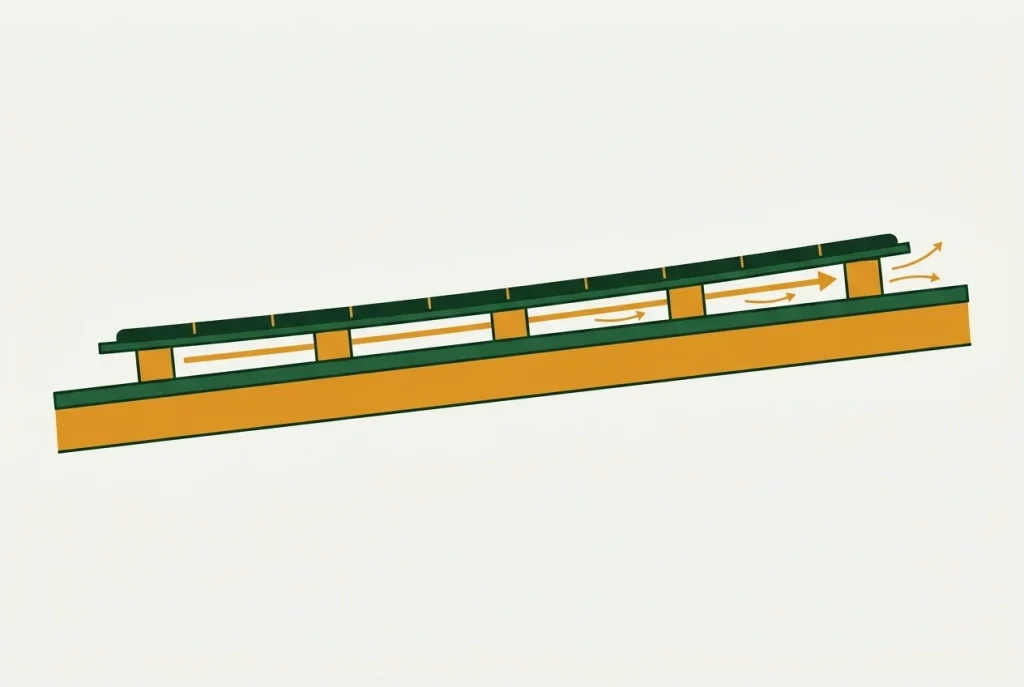
- Heat: a panel bonded flat to a metal roof with no air gap runs hotter, and heat reduces output and can shorten its life. Leaving a small gap for airflow helps.
- Foot traffic: many flexible panels are not designed to be walked on, and stepping on one can crack the cells. Only use it as a walkable surface if the manufacturer says so.
- Bending too far: flexing beyond the stated limit can cause micro-cracks that reduce output over time.
- Lifespan and warranty: warranties are often shorter than the 25 years common on glass panels.
- Cost per watt: you usually pay more per watt than for rigid panels, in return for weight and shape.
If you have a flat roof and the space, a rigid panel is usually the better long-term value. Our Renogy 100W rigid panel review covers that option.
How to mount a flexible panel
| Method | Advantages | Drawbacks |
|---|---|---|
| Flexible adhesive or sealant | Lowest profile; no holes in the roof | Hard to remove; little airflow behind the panel, so more heat |
| Screws or rivets through the eyelets | Removable; lets you add spacers for an air gap | Makes holes in the roof that need sealing |
| Spacers or a light frame | Best airflow and cooler running; easy to inspect | Adds height and a little weight |
If you’re looking for fasteners, the 3M Brand have multiple choices that serve their purpose well and keeps things securely in place.
Whichever method you choose, follow these three steps for better results;
- Keep the panel off any sharp edges,
- Avoid trapping water underneath, and
- Let the adhesive cure fully before driving.
How much solar do you need?
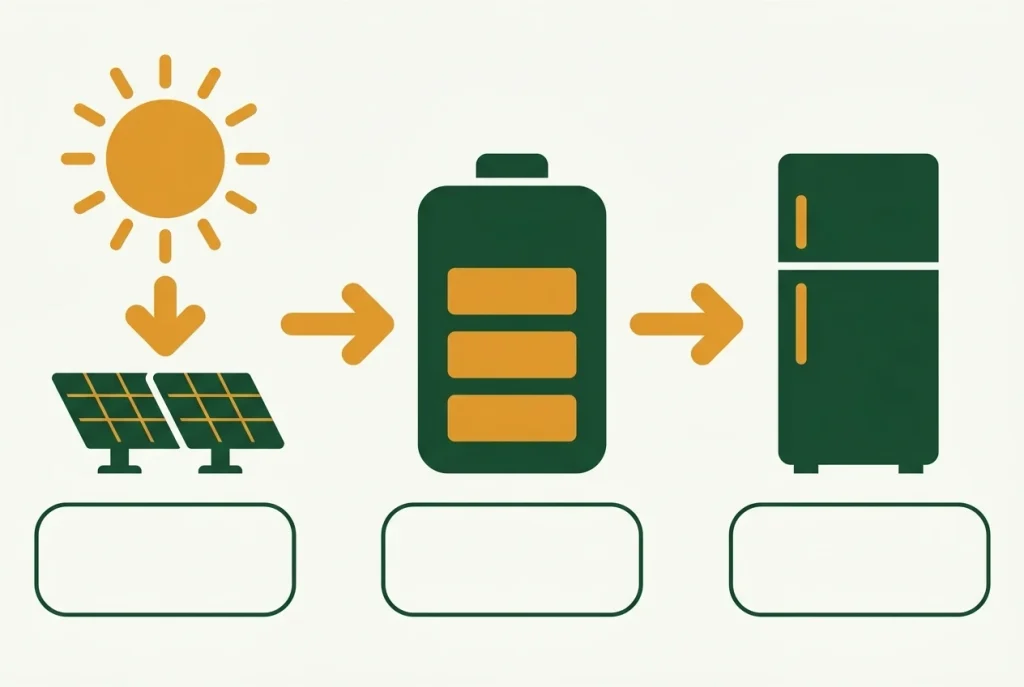
Size the panel by your daily energy use, not by the space you have. The formula is: panel watts = daily watt-hours × 1.25 ÷ peak sun hours. Our off-grid solar and battery calculator does the sums for you.
Worked example. A small 12V fridge (about 400Wh a day), lights (50Wh) and devices (150Wh) come to 600Wh. With 4.5 peak sun hours that is 600 × 1.25 ÷ 4.5 = about 170W, so two 100W panels cover it. In winter, with around 2.5 sun hours, the same load needs about 300W.
To help you find the average daily solar exposure over Australia use the BOM average daily solar exposure map.
Before you buy, check that the panels physically fit on your roof, leaving room for cables and mounting. Sun hours vary a lot across Australia, so use your own location’s figure.
Wiring and controllers
- Charge controller: if you charge a 12V battery, you need a solar charge controller set for your battery type (AGM or lithium). MPPT controllers are usually more efficient than PWM. A power station has one built in.
- Voltage limits: panels in series add voltage, and panels in parallel add current. Check the open-circuit voltage against your controller’s or power station’s maximum input. Our portable solar guide explains what to check.
- Fuses and cable size: fit a fuse or breaker near the battery and use cable rated for the current and the run length. Thin or long cable wastes power as heat.
- Get it checked: if you are unsure about any of this, have a licensed electrician look over a fixed installation.
Looking after a flexible panel
- Don’t walk or kneel on the panel unless it is rated to be walked on.
- Clean it with water and a soft cloth, and avoid abrasive pads.
- Inspect the edges and adhesive now and then, especially after long corrugated roads or a hot summer.
- Keep the manufacturer’s warranty terms and the receipt.
Pros and cons
Pros
- Very light compared with glass panels
- Thin and low-profile
- Follows gentle curves
- No frame to catch wind or branches
Cons
- Usually shorter warranty and lifespan
- Runs hotter if bonded flat with no air gap
- Can crack if bent too far or walked on
- Costs more per watt than rigid panels
Which type suits you?
- Curved roof or weight limit: flexible.
- Flat roof with space: rigid. See our Renogy 100W review.
- Camping and power stations: portable folding. See our best off-grid and portable solar panels roundup.
Related reviews and guides
- Best Off-Grid & Portable Solar Panels in Australia (2026)
- Portable & Foldable Solar Kits in Australia
- Renogy 100W Monocrystalline Solar Panel Review (AU)
- How to Calculate and Size Your Off-Grid Power System
- Off-Grid Solar & Battery Calculator
Frequently asked questions
Do flexible solar panels last as long as rigid ones?
Generally not. Flexible panels commonly have shorter warranties and can degrade faster, especially if they run hot. Check the warranty period and what it covers before you buy.
Can I walk on a flexible solar panel?
Only if the manufacturer says it is rated for foot traffic. Many are not, and stepping on one can crack the cells.
Do I need an air gap under a flexible panel?
It is a good idea. A small gap for airflow keeps the panel cooler, which helps output and lifespan. Bonding it flat to a metal roof traps heat.
How far can I bend a flexible panel?
Only as far as the manufacturer’s stated limit, which is often a gentle curve of around 30 degrees. Bending further risks micro-cracks.
Are flexible panels good for a 4WD roof rack or canopy?
They can be, because they are light and low-profile. Make sure the mounting copes with vibration and heat, and leave some airflow behind the panel.
Final thoughts
Flexible solar panels are a good solution for curved or weight-limited surfaces, as long as you accept shorter lifespans and a higher cost per watt. If you have a flat roof, a rigid panel is usually the better value. Work out how many watts you need with our calculator, then compare options on our Solar Panels hub.