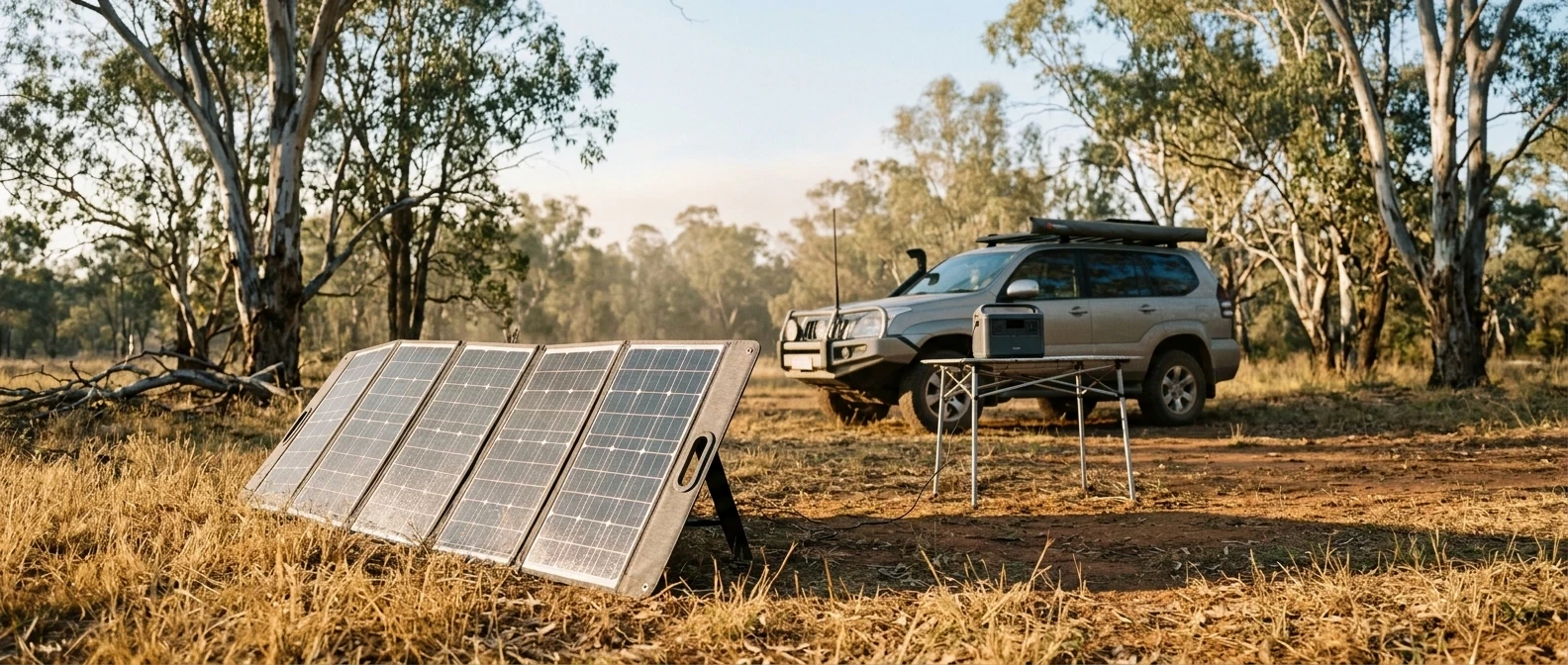
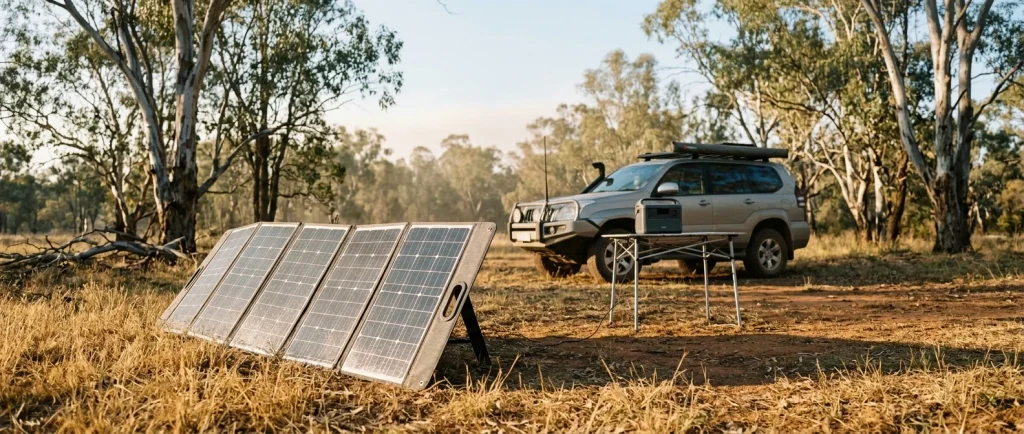
If you caravan off grid, camp or tour in a 4WD, portable solar is a great way to keep devices running without a generator. It is also where most people waste money. Usually that’s by buying a panel that does not match their power station or by guessing how many watts they need.
This guide explains the main types of portable and foldable solar kits. Also, how to size one properly for Australian conditions, and what to check before you buy.
Short answer: For most Australian campers, one or two 200W folding panels matched to your power station’s input limits is the best starting point. Check voltage and connector compatibility first, then size by daily watt-hours rather than guessing.
What Counts As A Portable or Foldable Solar Kit?
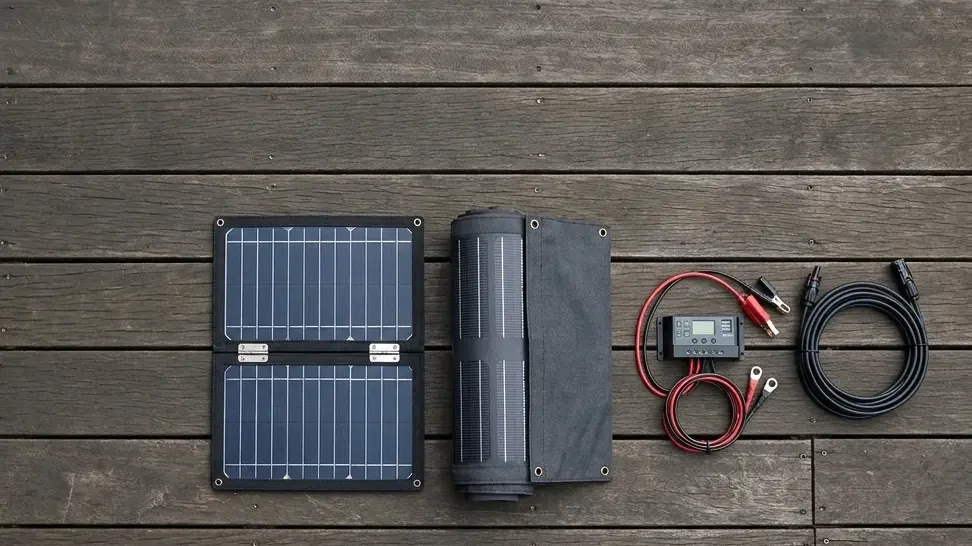
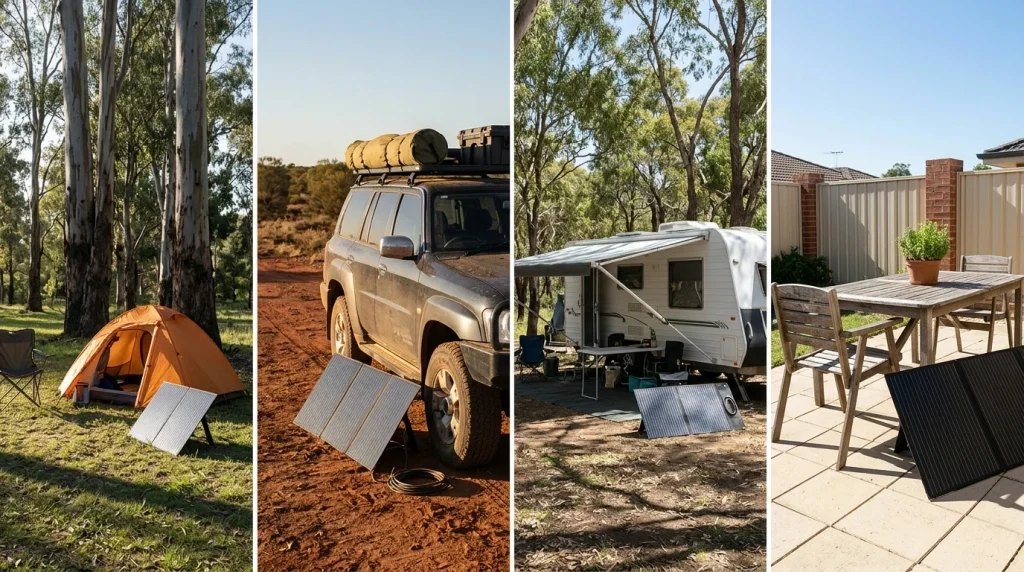
A portable solar kit is any panel setup you can carry, set up in minutes and pack away again. Most fall into four groups: folding panels with a kickstand, solar blankets, 12V kits with a regulator, and panels sold to match a specific power station.
Portable solar types at a glance
| Type | Typical size | Best for | Watch out for |
|---|---|---|---|
| Folding panel (hinged, kickstand) | 100–400W | Power stations and weekend camp setups | Bulky when folded; check the connector matches your unit |
| Solar blanket or mat | 120–250W | 4WD touring and light packing | Harder to angle at the sun; often costs more per watt |
| 12V kit with regulator | 100–200W | Charging a caravan or camper battery directly | The regulator must suit your battery type |
| Bifacial folding panel | 200W and up | Camps with light, reflective ground | Extra rear output depends on what is under the panel |
Folding panels
Folding panels are the most popular choice. They fold in half or thirds, carry like a briefcase and stand on built-in kickstands. If you are running a power station, this is the type most people end up with. See how one performs in our BLUETTI PV200 solar panel review.
Solar blankets
Blankets roll or fold flat, which suits drawer systems and tight packing. They are lighter and quieter to set up, but they lie flat or lean against something, so they are harder to point at the sun.
12V kits with a regulator
If you want to charge a caravan or camper battery directly, you need a panel plus a regulator (charge controller) set for your battery type. Power stations have this built in. A bare 12V battery does not.
Bifacial panels
Bifacial panels collect light on both sides. Pale sand or gravel under the panel can add output, but grass or dark soil adds little. Read our Anker SOLIX PS200 bifacial review for a field test.
How Much Solar Do You Actually Need?
Size your panel by how much energy you use each day, not by the biggest number on the box. The same method is built into our off-grid solar and battery calculator.
The formula is simple: panel watts = daily watt-hours × 1.25 ÷ peak sun hours. The 1.25 allows for losses in cables, controller and conversion.
Worked example. A small 12V fridge (about 400Wh a day), lights (50Wh) and phones and a laptop (150Wh) come to 600Wh a day. With 4.5 peak sun hours: 600 × 1.25 ÷ 4.5 = about 170W, so a 200W panel covers it in good sun. In winter, with around 2.5 sun hours, the same load needs about 300W.
Panel size by daily energy use
| Daily energy use | Example load | Panel watts at 4.5 sun hours | Panel watts at 2.5 sun hours (winter) |
|---|---|---|---|
| 300Wh | Lights, phones and a laptop | About 85W | About 150W |
| 600Wh | Small 12V fridge, lights and devices | About 170W | About 300W |
| 1,000Wh | Fridge, laptop, Starlink and extras | About 280W | About 500W |
| 1,500Wh | Heavier use with a TV or small appliances | About 420W | About 750W |
*NOTE: These are planning figures, not guarantees. Output drops with cloud, shade, heat and a poor angle, so add a margin if you rely on solar daily. For regional sun data, see the Bureau of Meteorology’s average daily solar exposure maps.
Check compatibility before you buy
This is where most expensive mistakes happen. Before buying a panel for a power station, check these four things in the manual:
- Maximum input voltage. Never exceed it. A panel’s open-circuit voltage rises in cold weather, so leave headroom.
- Maximum input watts and amps. Extra panel capacity is wasted if the unit limits input.
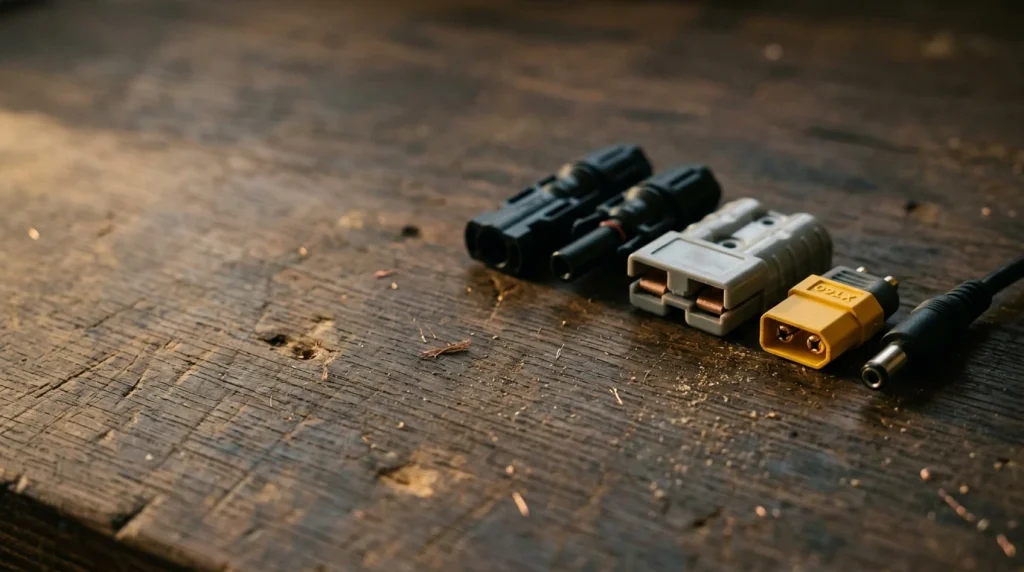
- Connector type. MC4, Anderson, XT60 and 8mm DC plugs are all common. Adapters exist, but check polarity.
- Series or parallel wiring. Series adds voltage, parallel adds current. Your unit’s limits decide which is safe.
- If you are choosing a power station first, our best portable power stations in Australia roundup lists the solar input limits for each.
Controllers: MPPT, PWM and Built-In
If the panel plugs into a power station, the controller is already inside, so you only need to match the plug and the limits. If you are charging a bare 12V battery, you need an external regulator. MPPT regulators are generally more efficient, especially in low light, while PWM regulators cost less. Make sure the setting matches your battery type, such as AGM or LiFePO4.
Setting up for best results
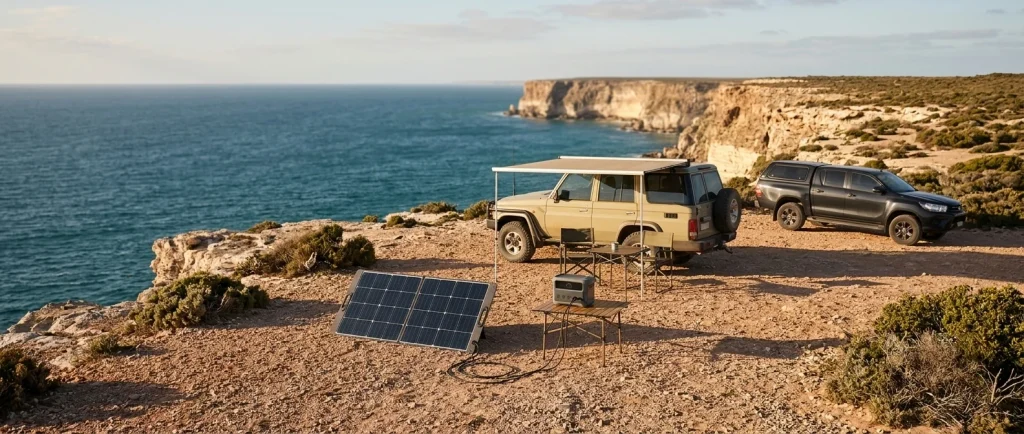
- Tilt toward the sun and adjust throughout the day. Even a small change in angle makes a difference.
- Avoid shade. A small shadow across one section of a panel can cut output far more than you would expect.
- Keep cables short and thick. Long thin leads waste power as heat.
- Keep panels cool and clean. Heat reduces output, and dust builds up quickly on dirt roads.
- Secure panels. Peg or weigh down against wind, and lock or tether them if you leave camp.
Some Of The Best Tips That People Learn The Hard Way
Common mistakes to avoid
- Guessing your power use. Check the watts on your fridge and devices, then estimate hours of use. A plug-in energy meter gives a real reading.
- Forgetting surge power. Compressors and motors draw more for a moment when they start, so check your power station’s inverter can handle it.
- Ignoring voltage limits. Compare the panel’s open-circuit voltage with your power station’s maximum solar input before connecting, especially when joining panels in series.
- Skimping on cables. Thin or very long leads lose power as heat, so use the supplied leads or properly rated cable.
References: Why people learn this the hard way
- Bills and labels hide the real picture, so people size systems on guesses.
- An undersized battery or inverter shuts down the moment a heavy appliance starts.
- Surge wattage gets forgotten, and motors are where it bites.
- Wrong wire gauge or non-DC breakers cause heat, voltage drop and fire risk.
- Skipping a multimeter check before wiring in an inverter can destroy equipment in seconds.
Pros and Cons of Portable Solar
Pros
- Move it to the sun and away from shade, which fixed panels cannot do.
- No installation, so it works with rental vehicles and for emergency use.
- Quiet and fuel-free compared with a generator.
Cons
- Takes up storage space and needs setting up each time.
- Can be stolen if left unattended.
- Costs more per watt than fixed roof panels.
Which type suits you?
| Use case | Suggested setup | Why |
|---|---|---|
| Weekend camper with a power station | One or two 100–200W folding panels | Easy to carry and quick to set up; stay within your unit’s input limits |
| 4WD touring | A 200W+ folding panel or a solar blanket | Packs flat in a drawer or on the roof rack |
| Caravan or camper trailer | 12V kit with a regulator, or a panel plus a DC-DC charger | Charges the battery directly with the right profile for your battery type |
| Home backup | Folding panels sized to your power station’s solar input | Store them indoors and deploy them quickly in a blackout |
Related reviews and guides
- Best Off-Grid & Portable Solar Panels in Australia (2026)
- BLUETTI PV200 Solar Panel Review
- Anker SOLIX PS200 Bifacial Solar Panel Review (AU)
- Renogy 100W Monocrystalline Solar Panel Review (AU)
- How to Calculate and Size Your Off-Grid Power System
- Off-Grid Solar & Battery Calculator
Frequently Asked Questions
Can a 200W folding panel run a fridge?
Often, in good sun. A 12V compressor fridge typically uses a few hundred watt-hours a day, which a 200W panel can cover on a clear day. Check your fridge’s daily consumption and carry enough battery to get through cloudy spells.
Do I need an MPPT controller?
Not if the panel plugs into a power station, because the controller is built in. For a bare 12V battery you do need a regulator, and MPPT is usually more efficient than PWM.
Can I connect two panels together?
Usually yes, but it depends on your unit’s input limits. Series wiring adds voltage and parallel wiring adds current, so check the maximum for both before connecting.
Do portable panels work on cloudy days?
Yes, but at a fraction of their rated output. Plan for lower yield and keep spare battery capacity.
How do I stop a portable panel being stolen or blown over?
Peg or weigh it down, and use a lock and cable or tether when you leave camp.
Final thoughts
The best portable solar kit is the one that matches your power station’s limits, suits how you travel and is sized to your real daily use. Start with a 200W folding panel, work out your numbers in our calculator, and add more panels only if you need them. Browse our Solar Panels hub for more reviews and guides.
To learn more about setting up solar, download the Clean Energy Council guide here.