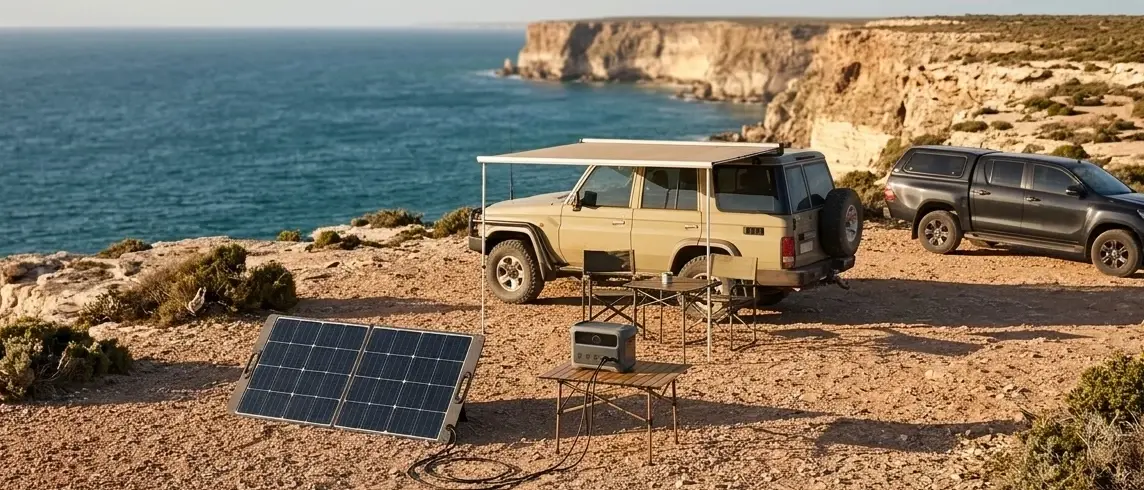
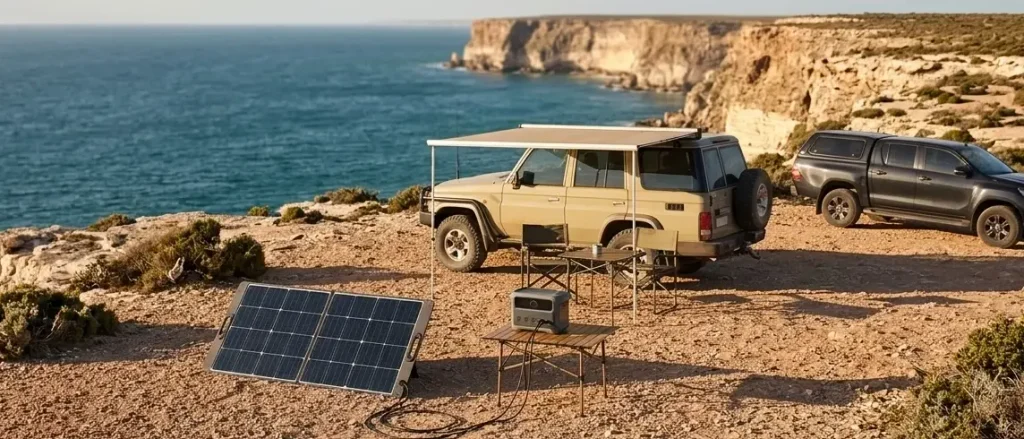
Testing the Anker SOLIX PS200 on the Great Australian Bight: panel in the sun with power station and the ocean for a backdrop.
When selecting a portable solar panel for 4WD touring, camper trailers, or remote work setups in Australia, raw wattage ratings on paper rarely tell the whole story. Between intense dust exposure, extreme UV radiation, and high ambient temperatures that degrade solar efficiency, panels built for light recreational use often fail in the Outback.
Over three weeks of field testing across coastal campsites and dry inland terrain, we evaluated the Anker SOLIX PS200 Bifacial Solar Panel. We paired it directly with popular portable power stations—including the Anker SOLIX C1000, BLUETTI AC180, and EcoFlow Delta 2—to measure real-world peak output, setup speed, thermal efficiency, and chassis durability under Australian sun.
Quick verdict
Anker SOLIX PS200 Bifacial Solar Panel
4.4out of 5
Build quality5 / 5
Solar output4.5 / 5
Portability4.2 / 5
Compatibility4 / 5
Overall value4.4 / 5
Best for: sand and gravel campsites, and dusty or wet conditions. Check first: your power station’s maximum solar input voltage (the PS200 is 57.6V open-circuit).
Our quick verdict on the Anker SOLIX PS200: top marks for build, with compatibility depending on your power station’s input limit.
Key Specifications & Features Overview
Feature / Specification
Anker SOLIX PS200 Benchmark
Rated Max Power
200W
Cell Type
N-Type Monocrystalline (Bifacial)
Bifacial Extra Yield
Up to +10% to +30% (depending on ground reflectivity)
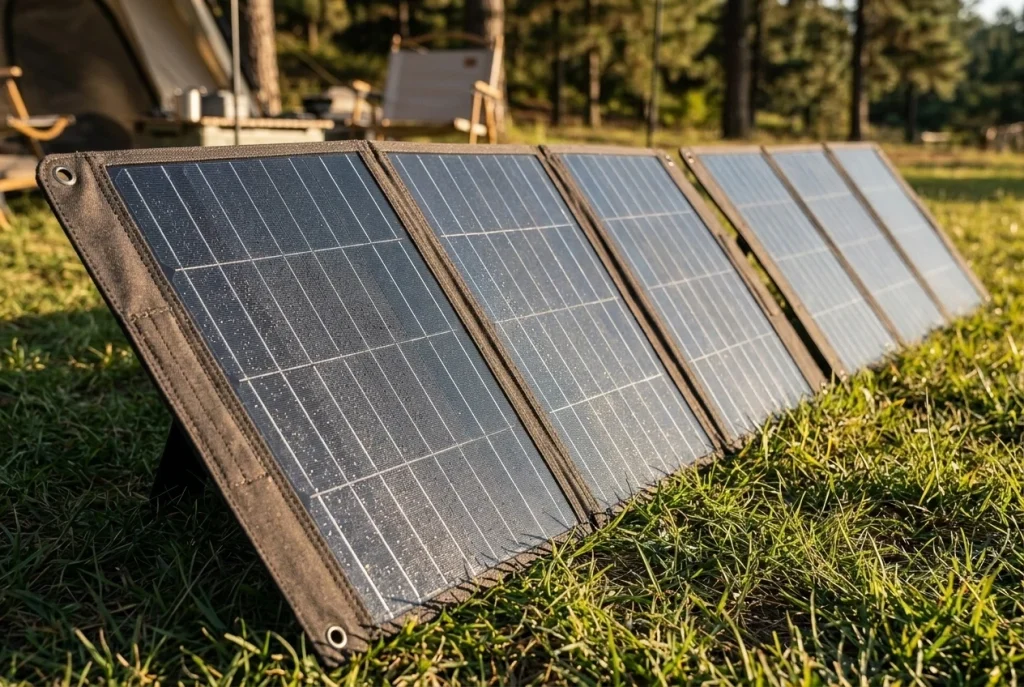
N-type bifacial cells under a textured ETFE coating, soaking up the afternoon sun at camp. Two sets side by side means twice the power.
Real-World Field Performance & Bifacial Solar Yield
The Bifacial Advantage on Australian Soil
The standout technical feature of the SOLIX PS200 is its N-type bifacial cell design. Traditional monofacial panels only harvest sunlight striking the front surface. The PS200 features a transparent back layer that allows ambient reflected light (albedo) from the ground surface to energize the rear side of the cells.
During our field tests around midday in unshaded conditions:
Red Soil / Dry Grass (Moderate Reflection): Delivered a stable 165W – 178W direct output.
Light Sand / Pale Gravel (High Reflection): Peak output spiked to 188W – 194W, approaching the theoretical 200W limit due to rear light absorption.
Angle Adjustment & Integrated Sun Position Finder
Optimal angle alignment is critical in southern Australian latitudes during winter months. The PS200 includes four pre-attached adjustable kickstands that range from 35° to 55°, alongside a built-in target bubble level for aligning the face directly perpendicular to the sun.
Is a Bifacial Panel Worth It?
Bifacial panels collect light on both sides, but how much the rear adds depends on what is under the panel. On pale sand and gravel, the PS200 reached 188W–194W in our tests. On red soil and dry grass it held at 165W–178W. So the extra yield is real on light, reflective ground and small on dark soil or grass.
If you mostly camp on grass, bitumen or leaf litter, you may not get much from the rear side alone. If you camp on sand, gravel or salt flats, it earns its keep. Prop the panel up so the rear can see the ground, and keep it clear of shade from your own gear. A pale tarp under the panel is a cheap way to experiment on dark ground.
Australian off-grid gear faces two major environmental enemies: fine bull-dust and sudden downpours.
IP68 Ingress Protection: While many budget folding solar blankets carry an IP65 or IP67 rating (resistant to splashing or temporary spray), the Anker SOLIX PS200 is IP68 certified. The panel junction box and cables can handle heavy rainstorms and complete submersion in shallow water without internal shorting.
ETFE Surface Lamination: The outer surface is laminated with durable ETFE (Ethylene Tetrafluoroethylene) plastic, which resists scratching from stray twigs, airborne gravel, and harsh UV yellowing over time.
Transport & Pack-Down: Folding down into a compact briefcase shape measuring 605 × 540 mm, it slides easily behind driver seats or underneath camper trailer bed frames. At 9.2 kg, it is sturdier than lightweight fabric blankets, but the rigidity provides necessary wind resistance when gusty breezes blow across open campsites.
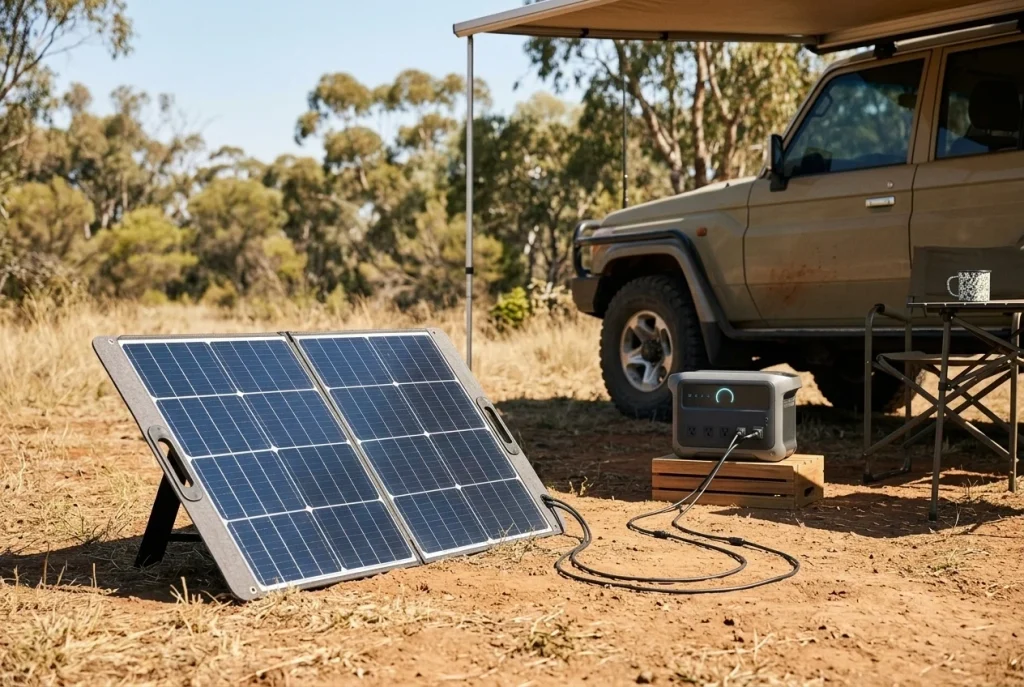
Solar Panel out in the sun, power station parked nearby the table and 4WD with awning. A simple, tidy off-grid charging setup for weekend camping or traveling nomads.
Universal Power Station Compatibility & Cabling
A common concern for buyers is whether an Anker panel locks them into an Anker-only ecosystem. It doesn’t, but voltage matters more than brand here.
The SOLIX PS200 terminates in standard MC4 solar connectors, and Anker includes an MC4-to-XT60i adapter cable in the box. Its open-circuit voltage is 57.6V (Anker lists −5% to +10%), and panel voltage rises in cold weather. Always check your power station’s maximum solar input voltage before connecting.
Anker SOLIX C1000: Solar input is listed at 11–60V, so the PS200 fits, but with little headroom. Confirm the exact figure in your manual, and check the C2000 and F2000 separately.
EcoFlow DELTA 2 and DELTA 2 Max: 11–60V. Within range at 57.6V, but only just, so be careful on cold mornings.
BLUETTI AC180: 12–60V. Same note: within range, with little margin. Check the AC200MAX manual for its own limit.
Not suitable: Don’t connect the PS200 to power stations with a lower limit, including the EcoFlow RIVER 2 (11–30V) and RIVER 2 Pro (11–50V). Exceeding the limit can damage the unit.
Never wire two PS200 panels in series. Their combined voltage (over 110V) is above the input limit of every unit listed here. Two panels in parallel keep the voltage the same and add current, which suits units that accept 15A and 500W, though the power station will cap the input at its own wattage limit.
High Real-World Efficiency: Bifacial N-type cells capture reflective ground light, noticeably boosting yield on sand and light gravel.
Top-Tier IP68 Rating: Maximum resistance against rain, creek splash, and fine Australian dust.
MC4 output: Allows connection to many modern solar generators
Universal Standard Connectors: MC4 output allows connection to many modern solar generators.
Rigid Kickstands: 4-point adjustment stability prevents panel bowing or blowing over in mild winds.
Cons
Weight: At 9.2 kg, it is heavier than ultra-flexible, unreinforced canvas blankets.
Cost: Premium pricing compared to standard monofacial 200W panels.
The Final Verdict: Should You Buy the Anker SOLIX PS200 in Australia?
The Anker SOLIX PS200 is a well-built 200W folding panel with an IP68 rating and a bifacial design that pays off on light, reflective ground. In our testing it delivered 165W–178W on red soil and dry grass and up to 194W on sand. *NOTE: Output will vary according to conditions
Buy it if you camp on sand or gravel, want a panel that handles dust and rain, and your power station’s maximum solar input voltage is above the panel’s open-circuit voltage.
Skip it if you mostly camp on grass or dark soil, where a cheaper monofacial 200W panel may perform similarly, if you need something lighter than 9.2 kg, or if your power station’s input limit is too low.